Monday, January 31, 2011
Winter clouds snow-laden, cotton fluff flying,
None or few the unfallen flowers.
Chill waves sweep through steep skies,
Yet earth's gentle breath grows warm.
Only heroes can quell tigers and leopards
...And wild bears never daunt the brave.
Plum blossoms welcome the whirling snow;
Small wonder flies freeze and perish.
- Mao
cigarette soliloquies
external exegesis
naked cave at lethe
yellow crane tower boulder
black wind blowing
To a Foiled Revolter or Revoltress.
1 COURAGE! my brother or my sister!
Keep on! Liberty is to be subserved, whatever occurs;
That is nothing, that is quelled by one or two failures,
or any number of failures,
Or by the indifference or ingratitude of the people,
or by any unfaithfulness,
Or the show of the tushes of power—soldiers, cannon,
penal statutes.
2 What we believe in waits latent forever through
Asia, Africa, Europe, North and South America,
Australia, Cuba, and all the islands and archi-
pelagoes of the sea.
3 What we believe in invites no one, promises nothing,
sits in calmness and light, is positive and com-
posed, knows no discouragement,
Waits patiently its time—a year—a century—a
hundred centuries.
4 The battle rages with many a loud alarm and fre-
quent advance and retreat,
The infidel triumphs—or supposes he triumphs,
The prison, scaffold, garrote, hand-cuffs, iron necklace
and anklet, lead-balls, do their work,
The named and unnamed heroes pass to other
spheres,
The great speakers and writers are exiled—they lie
sick in distant lands,
The cause is asleep—the strongest throats are still,
choked with their own blood,
The young men drop their eyelashes toward the
ground when they meet,
But for all this, liberty has not gone out of the place,
nor the infidel entered into possession.
5 When liberty goes out of a place, it is not the first
to go, nor the second or third to go,
It waits for all the rest to go—it is the last.
6 When there are no more memories of the superb
lovers of the nations of the world,
The superb lovers' names scouted in the public
gatherings by the lips of the orators,
Boys not christened after them, but christened after
traitors and murderers instead,
Tyrants' and priests' successes really acknowledged
anywhere, for all the ostensible appearance,
You or I walking abroad upon the earth, elated at
the sight of slaves, no matter who they are,
And when all life, and all the Souls of men and women
are discharged from any part of the earth,
Then shall the instinct of liberty be discharged from
that part of the earth,
Then shall the infidel and the tyrant come into
possession.
7 Then courage!
For till all ceases, neither must you cease.
8 I do not know what you are for, (I do not what I am
for myself, nor what any thing is for,)
But I will search carefully for it in being foiled,
In defeat, poverty, imprisonment—for they too are
great.
9 Did we think victory great?
So it is—But now it seems to me, when it cannot be
helped, that defeat is great,
And that death and dismay are great.
- Walt Whitman
In Memory Of The Paris Commune, Born March 18, 1871,
and Died In June The Same Year
What wingéd shape, with waving torch aflame,
Wild with winds of March, and streaming hair
Above the storm clouds, doth to men declare
What message, and a memory doth claim?
A star through drifting smoke of praise and blame -
The toilers' beacon, still to re-appear
With spring-tide hopes new quickening year by year
Since bright in Freedom's dawn the COMMUNE came.
Maligned, betrayed, short-lived to act and teach,
Whose blood lies still upon the hands that slew:
E'en now, when Labour knocks upon the gate
That shuts on Privilege, He thinks of you,
And what men dared and suffered, and their fate
Who ruled a City, once, for all and each.
Walter Crane
I Am The Clouds And The SKY
I am the clouds and the sky
I wonder what is unfolding below
I hear the cries of children and the screams of women
I see a holocaust unfolding before me
I want this horror to stop
But I am merely the clouds and the sky.
I pretend that all is well where I dwell
I feel the tempest of pain from sufferers
I touch the tormented hearts and souls
I worry the hurricane of death will never cease
I cry so that my tears may wash away the blood I see
But I am merely the clouds and the sky.
I understand the hurt and loss of those beneath me
I speak soothing words to assuage the injured grass
I dream the sun will shine through me and bring hope
I try to tornado this hurricane
I hope the evil will dissolve in my grasp
But I am merely the clouds and the sky.
Mohammad J. Alam
Friday, January 28, 2011
Expanded blog description:
The tide of revolution throughout the world is rising and in its wake the specter of socialism shows its teeth. Now is not the time to be neutral or complacent. You have noting to lose but your chains.
The title of this blog is a Haitian Voodoo Proverb. It means that the gods bless inhabit those who are strong. The Haitian revolution was the first successful slave revolt led by Toussaint L'Ouverture and Jean Jacques Dessalines (whom the background picture is of), both former slaves. Today capitalism keeps us in a different kind of slavery, but a slavery nonetheless. Marx believed in the scientific method and his belief was that humans were progressing from primitive communism, to feudalism, to capitalism and the next step would be industrial communism. Although I don't share his absolutist views, I do think his analysis is fairly accurate. However, I tend to agree with Proudhoun's Philosophy of Progress in which he states that what he believes in is a process rather than a finality. Evolution is a dynamic and constant process. We are taller than the people who lived in the middle ages and there are more of us. When the rich 5% own more than the bottom 90% the Plutocracy has to be abolished. Therefore, I am an abolitionist in the John Brown sense. An injury to one is an injury to all as the Knights of Labor put it.
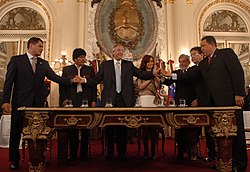
Bank of the South
Bolivarian Alternative
Bolivarian comes from Simon de Bolivar who led the nations of Bolivia, Colombia, Ecuador, Panama, and Venezuela to independence. The Bolivarian alternative is an insistence not on Globalization from the North, but a Globalization from the South or "from below." The Term Global South has two meanings: first and foremost, it is meant to indicate those nations until recently known as third world or euphemistically "developing" or "less developed." Second, it refers to the geographical location in which most of these countries lie. The Bolivarian alternative arose when South American nations rose up to oppose George W. Bush's plan for the Free Trade Area of the Americas (FTAA). This plan would have extended NAFTA to South America, thus multiplying the devastating results that NAFTA and neoliberalism had already produced.
Venezuela Analysis- a good source of news and analysis regarding Venezuela's Chavez regime.
and...
The HUGO CHAVEZ SHOW
Live! With Hugo Chavez!
Support Citgo and their US-Venezuela Low-income Heating Oil Program
and...
The HUGO CHAVEZ SHOW
Live! With Hugo Chavez!
Support Citgo and their US-Venezuela Low-income Heating Oil Program
Monday, January 24, 2011
Interestingly enough, despite the attempt by some radical socialists of today to say that gay rights are essential to socialism, socialism in the past has had a love-hate relationship with LGBT rights. Charles Fourier, Utopian socialist who coined the word feminism in 1837 defended same-sex sexuality. However, when Karl-Heinrich Ulrichs wrote Marx in the 1860s Marx passed the information on to Engels. Engels opposed the views espoused in the books calling "Uranians" "pederasts" and describing the practice of same-sex sexuality as perversion. After the Russian revolution of 1917 the Tsarist policies regarding private sex practices were reversed and gay sex was immediately legalized, however under Stalin conditions significantly worsened as they did under Mao as well. This does not mean that socialism is incompatible with LGBT rights. On the contrary, socialism means equality for everyone regardless or race, gender, sexual orientation or religion. However, some of the Communist regimes of the past have to make amends for the repression of LGBT people in those countries, and the repression of other groups as well. Marx's historical materialism means that we must learn from the mistakes of the past. Not only is repression of LGBT people morally wrong, it is also not a good tactic if you want the most people on your side. Any movement of, by and for the people must include ALL the people.
The Stonewall Riots - 1969 — A Turning Point in the Struggle for Gay and Lesbian Liberation
By Lionel Wright
Originally appeared in Socialism Today No. 40, July 1999
Something unremarkable happened on June 27, 1969 in New York's Greenwich Village, an event which had occurred a thousand times before across the U.S. over the decades. The police raided a gay bar.
At first, everything unfolded according to a time-honored ritual. Seven plain-clothes detectives and a uniformed officer entered and announced their presence. The bar staff stopped serving the watered-down, overpriced drinks, while their Mafia bosses swiftly removed the cigar boxes which functioned as tills. The officers demanded identification papers from the customers and then escorted them outside, throwing some into a waiting paddy-wagon and pushing others off the sidewalk.
But at a certain point, the "usual suspects" departed from the script and decided to fight back. A debate still rages over which incident sparked the riot. Was it a 'butch' lesbian dressed in man's clothes who resisted arrest, or a male drag queen who stopped in the doorway between the officers and posed defiantly, rallying the crowd?
Riot veteran and gay rights activist Craig Rodwell says: "A number of incidents were happening simultaneously. There was no one thing that happened or one person, there was just... a flash of group, of mass anger."
The crowd of ejected customers started to throw coins at the officers, in mockery of the notorious system of payoffs - earlier dubbed "gayola" - in which police chiefs leeched huge sums from establishments used by gay people and used "public morals" raids to regulate their racket. Soon, coins were followed by bottles, rocks, and other items. Cheers rang out as the prisoners in the van were liberated. Detective Inspector Pine later recalled, "I had been in combat situations, but there was never any time that I felt more scared than then."
Pine ordered his subordinates to retreat into the empty bar, which they proceeded to trash as well as savagely beating a heterosexual folk singer who had the misfortune to pass the doorway at that moment. At the end of the evening, a teenager had lost two fingers from having his hand slammed in a car door. Others received hospital treatment following assaults with police billy clubs.
People in the crowd started shouting "Gay Power!" And as word spread through Greenwich Village and across the city, hundreds of gay men and lesbians, black, white, Hispanic, and predominantly working class, converged on the Christopher Street area around the Stonewall Inn to join the fray. The police were now reinforced by the Tactical Patrol Force (TPF), a crack riot-control squad that had been specially trained to disperse people protesting against the Vietnam War.
Historian Martin Duberman describes the scene as the two dozen "massively proportioned" TPF riot police advanced down Christopher Street, arms linked in Roman Legion-style wedge formation: "In their path, the rioters slowly retreated, but - contrary to police expectations - did not break and run ... hundreds ... scattered to avoid the billy clubs but then raced around the block, doubled back behind the troopers, and pelted them with debris. When the cops realized that a considerable crowd had simply re-formed to their rear, they flailed out angrily at anyone who came within striking distance.
"But the protestors would not be cowed. The pattern repeated itself several times: The TPF would disperse the jeering mob only to have it re-form behind them, yelling taunts, tossing bottles and bricks, setting fires in trash cans. When the police whirled around to reverse direction at one point, they found themselves face-to-face with their worst nightmare: a chorus line of mocking queens, their arms clasped around each other, kicking their heels in the air Rockettes-style and singing at the tops of their sardonic voices:
'We are the Stonewall girls
We wear our hair in curls
We wear no underwear
We show our pubic hair...
We wear our dungarees
Above our nelly knees!'
"It was a deliciously witty, contemptuous counterpoint to the TPF's brute force." (Stonewall, Duberman, 1993) The following evening, the demonstrators returned, their numbers now swelled to thousands. Leaflets were handed out, titled "Get the Mafia and cops out of gay bars!" Altogether, the protests and disturbances continued with varying intensity for five days.
In the wake of the riots, intense discussions took place in the city's gay community. During the first week of July, a small group of lesbians and gay men started talking about establishing a new organization called the Gay Liberation Front. The name was consciously chosen for its association with the anti-imperialist struggles in Vietnam and Algeria. Sections of the GLF would go on to organize solidarity for arrested Black Panthers, collect money for striking workers, and link the battle for gay rights to the banner of socialism.
During the next year or so, lesbians and gay men built a Gay Liberation Front (GLF) or comparable body in Canada, France, Britain, Germany, Belgium, Holland, Australia, and New Zealand.
The word "Stonewall" has entered the vocabulary of lesbians, gay men, bisexuals, and transgendered (LGBT) people everywhere as a potent emblem of the gay community making a stand against oppression and demanding full equality in every area of life.
The GLF is no more, but the idea of Gay Power is as strong as ever. Meanwhile, in many countries and cities the concept of "gay pride" literally marches on each year in the form of an annual Gay Pride march.
The present generation of young LGBT people and many of today's gay rights activists were born or grew up after 1969. And over the intervening decades, politics in the U.S. have passed through a very different period. While there have been huge advances in the struggle for LGBT rights, there is still a long way to go to achieve full liberation as the growing attacks by the religious right makes very clear.
Developing Subculture
Why did the Stonewall events happen when they did? How did the initial actions of fewer than 200 people lead to both a wider protest and then the birth of Gay Liberation?
In his 1983 book Sexual Politics, Sexual Communities, the historian John D'Emilio has revealed the pre-history of Stonewall. The author shows how the process of industrialization and urbanization, and the movement of workers from plantations and family farms to wage labor in the cities, made it easier for Americans with same-sex desires to explore their sexuality. By the 1920s, a homosexual subculture had crystallized in San Francisco's Barbary Coast, the French quarter of New Orleans, and New York's Harlem and Greenwich Villages.
People with same-sex desires have existed throughout history. What has varied is the way society has viewed them, and how the people we now describe as LGBT regarded themselves at different stages.
The significance of the social change described above, and the emergence of a subculture, for the development of a gay rights movement is that an increasing number of individuals with same-sex desires were able to break out of isolation in small and rural communities. However discreetly, they learned of the existence of large numbers of other gay people and started to feel part of a wider gay community.
In society at large, the penalties for homosexuality were severe. State laws across the country criminalized same-sex acts, while simple affectionate acts in public such as two men or women holding hands could lead to arrest. Even declaring oneself as a gay man or lesbian could result in admission to a mental institution without a hearing.
Within the embryonic subculture, there were fewer places for lesbians than gay men because women generally had less economic independence, and it was therefore harder for a woman to break free from social norms and pursue same-sex interests. During the Second World War, all this changed. With the set routines of peacetime broken, gays and lesbians found more opportunities for freer sexual expression.
Women entered both the civilian workforce and the armed services in large numbers, and also had new-found spending power with which to explore their sexuality. In the documentary film Before Stonewall, a lesbian ex-servicewoman called Johnnie Phelps relates how she was called in with another female NCO to see the general-in-command of her battalion - which she estimated was "97% lesbian."
General Eisenhower told her he wanted to "ferret out" the lesbians from the battalion, and instructed her to draw up a list to that end. Both Phelps and the other woman politely informed the General that they would be pleased to make such a list, provided he was prepared to replace all the file clerks, drivers, commanders, etc. and that their own names would be at the top of the list! Eisenhower rescinded the order. A few years later as U.S. president, however, Eisenhower would get lists aplenty during the McCarthy witch-hunts that were unleashed against thousands of both suspected Communists and "sexual perverts."
Renewed Repression
With the return to peacetime conditions, the millions of Americans who had encountered gay people and relationships in the services or war economy saw this temporary opening-up of U.S. society come to an end. Most of the new wartime gay venues closed their doors, as service people were demobilized and the bulk of the new women workers were sent home from the factories.
The lid of sexual orthodoxy came crashing down, and a dark age was about to dawn for gay people. But the genie of lesbian and gay experimentation had been let out of the bottle. Things could never be quite the same again. One of the enduring effects of the war was the large number of lesbian and gay ex-service people who decided to stay in the port cities to retain some sexual freedom, away from their families and the pressure to marry.
In the 1940s and 1950s, post-war reconstruction and the shift to consumer production, taking place against the background of the Cold War, resulted in the authorities heavily promoting the model of the orthodox nuclear family to buttress the social and economic system of capitalism. The other side of the coin was a clampdown on those who stepped out of the magic circle of matrimony, parenthood, and homemaking by engaging in same-sex relationships.
The inquiries of the House Un-American Activities Committee led to thousands of homosexuals losing their jobs in government departments. The ban on the employment of homosexuals at the federal level remained in place until 1975. In the District of Columbia alone, there were 1,000 arrests each year in the early 1950s. In every state, local newspapers published the names of those charged together with their place of work, resulting in many workers getting fired. The postal service opened the mail of LGBT people and passed on names. Colleges maintained lists of suspected gay students.
The Birth of Gay Rights
It was against this hostile background that the gay rights movement in the U.S. came into existence. In 1948, Harry Hay, a gay man and long-standing member of the U.S. Communist Party (CP), decided to set up a homosexual rights group. This was the first chapter in what gay people at the time described as the "homophile" movement.
Like all Communist Parties around the world, the U.S. party claimed to uphold the tradition of the October Revolution in Russia. One of the early measures of the Bolsheviks had been to end the criminalization of gay people. But by the 1930s, the rise of the Stalinist bureaucracy had resulted in the resumption of anti-gay policies both in the Soviet Union and world Communist Parties.
In this situation, determined to pursue his project, Hay asked to be expelled from the CP. In view of his long service, the party declined his request. Together with a small group of collaborators including other former CP members, Hay launched the Mattachine Society (MS) in 1950. This took its name from a mysterious group of anti-establishment musicians in the Middle Ages, who only appeared in public in masks, and were possibly homosexual.
D'Emilio describes the program of the Mattachine Society as unifying isolated homosexuals, educating homosexuals to see themselves as an oppressed minority, and leading them in a struggle for their own emancipation. The MS organized local discussion groups to promote "an ethical homosexual culture." These argued that "emotional stress and mental confusion" among gay men and lesbians was "socially conditioned."
Notwithstanding the Stalinist degeneration of the CP in which Hay had received two decades of training, the MS founders clearly applied Marxist methods to understand the position of gay people and chart a way forward. For the structure of Mattachine, Hay utilized the methods of secrecy which the CP had employed in the face of attacks by the authorities, but which also developed against the background of the undemocratic methods of Stalinism in the workers' movement.
To combat the persecution facing gay people, the Mattachine Society was based on a network of cells arranged in five tiers, or "orders." Hay and the other leaders comprised the fifth order, but would be unknown to members at first and second "order" levels. For three years, the MS steadily expanded its network of discussion groups. Growth accelerated in 1952 after MS won a famous victory over the police when charges against a Mattachine member in Los Angeles were dropped, following a campaign of fliers by a front organization called the "Citizens Committee to Outlaw Entrapment."
However, the following year, after a witch-hunting article by a McCarthyite journalist in Los Angeles, the fifth order decided to organize a "democratic convention." When this took place, the Hay group was criticized from the floor by conservative and anti-Communist elements who demanded that the MS introduce loyalty oaths, which was a standard McCarthyite tactic. The radical leadership managed to defeat all the opposition resolutions, and the demand for a loyalty oath never gained a majority in Mattachine.
Nevertheless, Hay and his comrades decided not to stand for positions in the organization they had established and built. This effectively handed the group over to the conservatives. Many who had supported the original aims left in disgust, and it took two years for the membership to be built up again. If the Hay group had stayed active, it could have offered a pole of attraction for militant LGBT people. As it was, the movement was thrown back and a decade was lost.
Whereas the Mattachine founders had advocated an early version of "gay pride," the new leadership reflected the social prejudice prevalent against homosexuals. The new MS president, Kenneth Burns, wrote in the Society journal, "We must blame ourselves for our own plight ... When will the homosexual ever realize that social reform, to be effective, must be preceded by personal reform?"
The position of the new leadership was that gay people could not fight for changes in U.S. society but had to look to "respectable" doctors, psychiatrists, etc. through whom to ingratiate themselves with the authorities in the hope of more favorable treatment. But the problem was that the vast majority of such figures advocated the idea that homosexuality was a sickness.
Towards the end of this period, when a professional named Albert Ellis told a homophile conference that "the exclusive homosexual is a psychopath," someone in the audience shouted: "Any homosexual who would come to you for treatment, Dr. Ellis, would have to be a psychopath!"
The Rise of Gay Activism
It is thought that many LGBT people who had yet to "come out" (publicly identify themselves as homosexual) became workers in the black civil rights campaign that began in the 1950s. By the following decade, the influence of the civil rights movement was making itself felt within the homophile movement. The "accommodationist" establishment of people such as Burns increasingly came under attack from a fresh generation of militant activists.
Eventually, in both the Mattachine Society and a similarly conservative lesbian group called the Daughters of Bilitis (DOB), the leadership chose to dissolve the national structure rather than see the organization fall into the hands of radicals. Individual MS and DOB branches then continued on a free-standing basis. In these and other city-based groups, militant leaders managed to win majorities, often after colossal battles.
Within this process, an influential figure was astronomer Frank Kameny, who had been fired from a government job in the anti-gay purges. After unsuccessfully fighting victimization in the courts, he concluded that the U.S. government "had declared war on" him and decided to become a full-time gay rights activist. Kameny was scathing about the old leadership of the homophile movement in their craven deference towards the medical establishment: "The prejudiced mind is not penetrated by information, and is not educable." The real experts on homosexuality were homosexuals, he said.
Referring to the organizations of the black civil rights movement, Frank Kameny noted: "I do not see the NAACP and CORE worrying about which chromosome and gene produced a black skin, or about the possibility of bleaching the Negro." As the struggles of U.S. blacks produced slogans such as "Black is Beautiful," Kameny coined the slogan "Gay is Good" and eventually persuaded the homophile movement to adopt this in the run-up to Stonewall.
The militant homophile campaigners started public picketing with placards and other direct actions, and mounted an offensive against the police and government over criminal entrapment, the employment ban, and a range of other issues.
Twenty years after Harry Hay had first conceived the idea of the Mattachine Society, U.S. society had undergone a transformation. The rise of a women's movement (with lesbians prominent among the organizers), the shift among black people from a civil rights to a black power movement (parts of which embraced socialist ideas), a revolt against the U.S. war in Vietnam on American campuses influenced by the May 1968 events in France, plus the side effects of other developments such as a rebellion against establishment values in dress and personal relationships among groups such as the hippies, all contributed to gay and lesbian rights campaigns moving into a more militant phase.
One of the strands within the Gay Liberation Front argued that a revolutionary struggle against capitalism to build a socialist society was needed to finally end the oppression of gay people.
Craig Rodwell concludes: "There was a very volatile active political feeling, especially among young people ... when the night of the Stonewall Riots came along, just everything came together at that one moment. People often ask what was special about that night ... There was no one thing special about it. It was just everything coming together, one of those moments in history that if you were there, you knew, this is it, this is what we've been waiting for."
ANALYSIS OF THE CLASSES IN CHINESE SOCIETY
March 1926
This article was written by Comrade Mao Tse-tung to combat two deviations then to be found in the Party. The exponents of the first deviation, represented by Chen Tu-hsiu, were concerned only with co-operation with the Kuomintang and forgot about the peasants; this was Right opportunism. The exponents of the second deviation, represented by Chang Kuo-tao, were concerned only with the labour movement, and likewise forgot about the peasants; this was "Left" opportunism. Both were aware that their own strength was inadequate, but neither of them knew where to seek reinforcements or where to obtain allies on a mass scale. Comrade Mao Tse-tung pointed out that the peasantry was the staunchest and numerically the largest ally of the Chinese proletariat, and thus solved the problem of who was the chief ally in the Chinese revolution. Moreover, he saw that the national bourgeoisie was a vacillating class and predicted that it would disintegrate during the upsurge of the revolution, with its right-wing going over to the side of imperialism. This was borne out by the events of 1927.
Who are our enemies? Who are our friends? This is a question of the first importance for the revolution. The basic reason why all previous revolutionary struggles in China achieved so little was their failure to unite with real friends in order to attack real enemies. A revolutionary party is the guide of the masses, and no revolution ever succeeds when the revolutionary party leads them astray. To ensure that we will definitely achieve success in our revolution and will not lead the masses astray, we must pay attention to uniting with our real friends in order to attack our real enemies. To distinguish real friends from real enemies, we must make a general analysis of the economic status of the various classes in Chinese society and of their respective attitudes towards the revolution.
What is the condition of each of the classes in Chinese society?
The landlord class and the comprador class.[1] In economically backward and semi-colonial China the landlord class and the comprador class are wholly appendages of the international bourgeoisie, depending upon imperialism for their survival ant growth. These classes represent the most backward and most reactionary relations of production in China and hinder the development of her productive forces. Their existence is utterly incompatible with the aims of the Chinese revolution. The big landlord and big comprador classes in particular always side with imperialism and constitute an extreme counterrevolutionary group. Their political representatives are the Étatistes [2] and the right-wing of the Kuomintang.
The middle bourgeoisie. This class represents the capitalist relations of production in China in town and country. The middle bourgeoisie, by which is meant chiefly the national bourgeoisie, [3] is inconsistent in its attitude towards the Chinese revolution: they feel the need for revolution and favour the revolutionary movement against imperialism and the warlords when they are smarting under the blows of foreign capital and the oppression of the warlords, but they become suspicious of the revolution when they sense that, with the militant participation of the proletariat at home and the active support of the international proletariat abroad, the revolution is threatening the hope of their class to attain the status of a big bourgeoisie. Politically, they stand for the establishment of a state under the rule of a single class, the national bourgeoisie. A self-styled true disciple of Tai Chi-tao [4] wrote in the Chen Pao, [5] Peking, "Raise your left fist to knock down the imperialists and your right to knock down the Communists." These words depict the dilemma and anxiety of this class. It is against interpreting the Kuomintang's Principle of the People's Livelihood according to the theory of class struggle, and it opposes the Kuomintang's alliance with Russia and the admission of Communists [6] and left-wingers. But its attempt to establish a state under the rule of the national bourgeoisie is quite impracticable, because the present world situation is such that the two major forces, revolution and counter-revolution, are locked in final struggle. Each has hoisted a huge banner: one is the red banner of revolution held aloft by the Third International as the rallying point for all the oppressed classes of the world, the other is the white banner of counterrevolution held aloft by the League of Nations as the rallying point for all the counter-revolutionaries of the world. The intermediate classes are bound to disintegrate quickly, some sections turning left to join the revolution, others turning right to join the counter-revolution; there is no room for them to remain "independent". Therefore the idea cherished by China's middle bourgeoisie of an "independent" revolution in which it would play the primary role is a mere illusion.
The petty bourgeoisie. Included in this category are the owner-peasants, [7] the master handicraftsmen, the lower levels of the intellectuals--students, primary and secondary school teachers, lower government functionaries, office clerks, small lawyers--and the small traders. Both because of its size and class character, this class deserves very close attention. The owner-peasants and the master handicraftsmen are both engaged in small-scale production. Although all strata of this class have the same petty-bourgeois economic status, they fall into three different sections. The first section consists of those who have some surplus money or grain, that is, those who, by manual or mental labour, earn more each year than they consume for their own support. Such people very much want to get rich and are devout worshipers of Marshal Chao; [8] while they have no illusions about amassing great fortunes, they invariably desire to climb up into the middle bourgeoisie. Their mouths water copiously when they see the respect in which those small moneybags are held. People of this sort are timid, afraid of government officials, and also a little afraid of the revolution. Since they are quite close to the middle bourgeoisie in economic status, they have a lot of faith in its propaganda and are suspicious of the revolution. This section is a minority among the petty bourgeoisie and constitutes its right-wing. The second section consists of those who in the main are economically self-supporting. They are quite different from the people in the first section; they also want to get rich, but Marshal Chao never lets them. In recent years, moreover, suffering from the oppression and exploitation of the imperialists, the warlords, the feudal landlords and the big comprador-bourgeoisie, they have become aware that the world is no longer what it was. They feel they cannot earn enough to live on by just putting in as much work as before. To make both ends meet they have to work longer hours, get up earlier, leave off later, and be doubly careful at their work. They become rather abusive, denouncing the foreigners as "foreign devils", the warlords as "robber generals" and the local tyrants and evil gentry as "the heartless rich". As for the movement against the imperialists and the warlords, they; merely doubt whether it can succeed (on the ground that the foreigners and the warlords seem so powerful), hesitate to join it and prefer to be neutral, but they never oppose the revolution. This section is very numerous, making up about one-half of the petty bourgeoisie.
The third section consists of those whose standard of living is falling. Many in this section, who originally belonged to better-off families, are undergoing a gradual change from a position of being barely able to manage to one of living in more and more reduced circumstances. When they come to settle their accounts at the end of each year, they are shocked, exclaiming, "What? Another deficit!" As such people have seen better days and are now going downhill with every passing year, their debts mounting and their life becoming more and more miserable, they "shudder at the thought of the future". They are in great mental distress because there is such a contrast between their past and their present. Such people are quite important for the revolutionary movement; they form a mass of no small proportions and are the left-wing of the petty bourgeoisie. In normal times these three sections of the petty bourgeoisie differ in their attitude to the revolution. But in times of war, that is, when the tide of the revolution runs high and the dawn of victory is in sight, not only will the left-wing of the petty bourgeoisie join the revolution, but the middle section too may join, and even tight-wingers, swept forward by the great revolutionary tide of the proletariat and of the left-wing of the petty bourgeoisie, will have to go along with the "evolution." We can see from the experience of the May 30th Movement [9] of 1925 and the peasant movement in various places that this conclusion is correct.
The semi-proletariat. What is here called the semi-proletariat consists of five categories: (1) the overwhelming majority of the semi-owner peasants, [10] (2) the poor peasants, (3) the small handicraftsmen, (4) the shop assistants [11] and (5) the pedlars. The overwhelming majority of the semi-owner peasants together with the poor peasants constitute a very large part of the rural masses. The peasant problem is essentially their problem. The semi-owner peasants, the poor peasants and the small handicraftsmen are engaged in production on a still smaller scale than the owner-peasants and the master handicraftsmen. Although both the overwhelming majority of the semi-owner peasants and the poor peasants belong to the semi-proletariat, they may be further divided into three smaller categories, upper, middle and lower, according to their economic condition. The semi-owner peasants are worse off than the owner-peasants because every year they are short of about half the food they need, and have to make up this deficit by renting land from others, selling part of their labour power, or engaging in petty trading. In late spring and early summer when the crop is still in the blade and the old stock is consumed, they borrow at exorbitant rates of interest and buy grain at high prices; their plight is naturally harder than that of the owner-peasants' who need no help from others, but they are better off than the poor' peasants. For the poor peasants own no land, and receive only half the harvest or even less for their year's toil, while the semi-owner` peasants, though receiving only half or less than half the harvest of land rented from others, can keep the entire crop from the land they own. The semi-owner peasants are therefore more revolutionary than the owner-peasants, but less revolutionary than the poor peasants. The poor peasants are tenant-peasants who are exploited by the landlords. They may again be divided into two categories according to their economic status. One category has comparatively adequate farm implements and some funds. Such peasants may retain half the product of their year's toil. To make up their deficit they cultivate side crops, catch fish or shrimps, raise poultry or pigs, or sell part of their labour power, and thus eke out a living, hoping in the midst of hardship and destitution to tide over the year. Thus their life is harder than that of the semi-owner peasants, but they are better off than the other category of poor peasants. They ate more revolutionary than the semi-owner peasants, but less revolutionary than the other category of poor peasants. As for the latter, they have neither adequate farm implements nor funds nor enough manure, their crops are poor, and, with little left after paying rent, they have even greater need to sell part of their labour power. In hard times they piteously beg help from relatives and friends, borrowing a few tou or sheng of grain to last them a few days, and their debts pile up like loads on the backs of oxen. They are the worst off among the peasants and are highly receptive to revolutionary propaganda. The small handicraftsmen are called semi-proletarians because, though they own some simple means of production and moreover are self-employed, they too are often forced to sell part of their labour power and are somewhat similar to the poor peasants in economic status. They feel the constant pinch of poverty and dread of unemployment, because of heavy family burdens and the gap between their earnings and the cost of living; in this respect too they largely resemble the poor peasants. The shop assistants are employees of shops and stores, supporting their families on meagre pay and getting an increase perhaps only once in several years while prices rise every year. If by chance you get into intimate conversation with them, they invariably pour out their endless grievances. Roughly the same in status as the poor peasants and the small handicraftsmen, they are highly receptive to revolutionary propaganda. The pedlars, whether they carry their wares around on a pole or set up stalls along the street, have tiny funds and very small earnings, and do not make enough to feed and clothe themselves. Their status is roughly the same as that of the poor peasants, and like the poor peasants they need a revolution to change the existing state of affairs.
The proletariat. The modern industrial proletariat numbers about two million. It is not large because China is economically backward. These two million industrial workers are mainly employed in five industries--railways, mining, maritime transport, textiles and shipbuilding--and a great number are enslaved in enterprises owned by foreign capitalists. Though not very numerous, the industrial proletariat represents China's new productive forces, is the most progressive class in modern China and has become the leading force in the revolutionary movement. We can see the important position of the industrial proletariat in the Chinese revolution from the strength it has displayed in the strikes of the last four years, such as the seamen's strikes, [12] the railway strike, [13] the strikes in the Kailan and Tsiaotso coal mines, [14] the Shameen strike [15] and the general strikes in Shanghai and Hong Kong [16] after the May 30th Incident. The first reason why the industrial workers hold this position is their concentration. No other section of the people is so concentrated. The second reason is their low economic status. They have been deprived of all means of production, have nothing left but their hands, have no hope of ever becoming rich and, moreover, are subjected to the most ruthless treatment by the imperialists, the warlords and the bourgeoisie. That is why they are particularly good fighters. The coolies in the cities are also a force meriting attention. They are mostly dockers and rickshaw men, and among them, too, are sewage carters and street cleaners. Possessing nothing but their hands, they are similar in economic status to the industrial workers but are less concentrated and play a less important role in production. There is as yet little modern capitalist farming in China. By rural proletariat we mean farm labourers hired by the year, the month or the day. Having neither land, farm implements nor funds, they can live only by selling their labour power. Of all the workers they work the longest hours, for the lowest wages, under the worst conditions, and with the least security of employment. They are the most hard-pressed people in the villages, and their position in the peasant movement is as important as that of the poor peasants.
Apart from all these, there is the fairly large lumpen-proletariat, made up of peasants who have lost their land and handicraftsmen who cannot get work. They lead the most precarious existence of all. In every part of the country they have their secret societies, which were originally their mutual-aid organizations for political and economic struggle, for instance, the Triad Society in Fukien and Kwangtung, the Society of Brothers in Hunan, Hupeh, Kweichow and Szechuan, the Big Sword Society in Anhwei, Honan and Shantung, the Rational Life Society in Chihli [17] and the three northeastern provinces, and the Green Band in Shanghai and elsewhere [18] One of China's difficult problems is how to handle these people. Brave fighters but apt to be destructive, they can become a revolutionary force if given proper guidance.
To sum up, it can be seen that our enemies are all those in league with imperialism--the warlords, the bureaucrats, the comprador class, the big landlord class and the reactionary section of the intelligentsia attached to them. The leading force in our revolution is the industrial proletariat. Our closest friends are the entire semi-proletariat and petty bourgeoisie. As for the vacillating middle bourgeoisie, their right-wing may become our enemy and their left-wing may become our friend but we must be constantly on our guard and not let them create confusion within our ranks.
NOTES
1 A comprador, in the original sense of the word, was the Chinese manages or the senior Chinese employee in a foreign commercial establishment. The compradors served foreign economic interests and bad close connection with imperialism and foreign capital.
2 The Étatistes were a handful of shameless fascist politicians who at that time formed the Chinese Étatiste Youth League, later renamed the Chinese Youth Party. They made counter-revolutionary careers for themselves by opposing the Communist Party and the Soviet Union and received subsidies from the various groups of reactionaries in power and from the imperialists.
3 For further discussion of the role of the national bourgeoisie, see "The Chinese Revolution and the Chinese Communist Party", Chapter 2, Section 4, Selected Works of Mao Tse-tung, Vol. II.
4 Tai Chi-tao joined the Kuomintang in his youth and for a time was Chiang Kai-shek's partner in stock exchange speculation. After Sun Yat-sen's death in 1925 he carried on anti-Communist agitation and prepared the ground ideologically for Chiang Kai-shek's counter-revolutionary coup d'état in 1927. For years be was a faithful running dog to Chiang Kai-shek in the counter-revolution. He committed suicide in February 1949, driven to despair by the imminent doom of Chiang Kai-shek's regime.
5 The Chen Pao was the organ of the Association for the Study of Constitutional Government, a political group which supported the rule of the Northern warlords.
6 In 1923 Sun Yat-sen, with the help of the Chinese Communist Party, decided to reorganize the Kuomintang bring about Kuomintang-Communist co-operation and admit members of the Communist Party into the Kuomintang. In January 1924 he convened in Canton the Kuomintang's First National Congress at which he laid down the Three Great Policies--alliance with Russia, co-operation with the Communist Party and assistance to the peasants and workers. Mao Tse-tung, Li Ta-chao, Lin Po-chu, Chu Chiu-pai and other comrades attended the Congress and played an important part in helping the Kuomintang to take the road of revolution. Some of these comrades were elected members, and others alternate members, of the Central Executive Committee of the Kuomintang.
7 By owner-peasants Comrade Mao Tse-tung means the middle peasants.
8 Marshal Chao is Chao Kung-ming, God of Wealth in Chinese folklore.
9 The May 30th Movement was the nation-wide anti-imperialist movement in protest against the massacre of the Chinese people by the British police in Shanghai on May 30 1925. Earlier that month, major strikes had broken out in Japanese-owned textile mills in Tsingtao and Shanghai, which the Japanese imperialists and the Northern warlords who were their running dogs proceeded to suppress. On May 15 the Japanese textile mill-owners in Shanghai shot and killed the worker Ku Cheng-hung and wounded a dozen others. On May 28 eight workers were slaughtered by the reactionary government in Tsingtao. On May 30 more than two thousand students in Shanghai agitated in the foreign concessions in support of the workers and for the recovery of the foreign concessions. They rallied more than ten thousand people before the British police headquarters, shouting such slogans as "Down with imperialism!" and "People of China, unite!" The British imperialist police opened fire, killing and wounding many students. This became known as the May 30th Massacre. It immediately aroused country-wide indignation, and demonstrations and strikes of workers, students and shopkeepers were held everywhere, forming a tremendous anti-imperialist movement.
10 By "the overwhelming majority of the semi-owner peasants", Comrade Mao Tse-tung is here referring to the impoverished peasants who worked partly on their own land and partly on land rented from others.
11 There were several strata of shop assistants in old China. Here Comrade Mao Tse-tung is referring to the largest. There was also the lower stratum of shop assistants who led the life of proletarians.
12 The seamen's strikes were staged by the seamen at Hongkong and by the crews of the Yangtse River steamers early in 1922. The Hongkong seamen held out for eight weeks. After a bitter and bloody struggle, the British imperialist authorities in Hongkong were finally forced to raise wages, lift the ban on the Seamen's Union, release the arrested workers and indemnify the families of the martyrs. The crews of the Yangtze steamers went on strike soon afterwards, carried on the struggle for two weeks and also won victory.
13 Immediately after its founding in 1922-23 the Chinese Communist Party set about organizing the railway worker. In 1922-23 strikes took place under the Party's leadership on all the trunk lines. The best known was the general strike on the Peking-Hankow Railway which began on February 4, 1923. It was a fight for the freedom to organize a general trade union. On February 7 the Northern warlords Wu Pei-fu and Hsiao Yao-nan, who were backed by British imperialism, butchered the strikers. This became known as the February 7th Massacre.
14 The Kailan Coal Mines was an inclusive name for the large contiguous Kaiping and Luanchow coalfields in Hopei Province, then employing over fifty thousand workers. During the Yi Ho Tuan Movement of 1900 the British imperialists seized the Kaiping mines. Subsequently the Chinese organized the Luanchow Coal Mining Company, which was later incorporated into the Kailan Mining Administration. Both coalfields thus came under the exclusive control of British imperialism. The Kailan strike took place in October 1922. The Tsiaotso Coal Mines, situated in Honan Province, are also well known in China. The Tsiaotso strike lasted from July 1 to August 9, 1925
15 Shameen, a section of the city of Canton, was held on lease by British imperialism. In July 1924 the British imperialists who ruled it issued a new police regulation requiring all Chinese to produce passes with photos on leaving or entering the area. But foreigners were exempt. On July 15 the workers in Shameen went on strike to protest against this preposterous measure, which the British imperialists were finally forced to cancel.
16 Following the May 30th Incident in Shanghai, general strikes broke out on June 1, 1925 in Shanghai and on June 19 in Hong Kong. More than 200,000 workers took part in Shanghai and 250,000 in Hong Kong. The big Hong Kong strike, with the support of the people throughout the country, lasted sixteen months. It was the longest strike in the history of the world labour movement.
17 Chihli was the old name for Hopei Province.
18 The Triad Society, the Society of Brothers, the Big Sword Society, the Rational Life Society and the Green Band were primitive secret organizations among the people. The members were mainly bankrupt peasants, unemployed handicraftsmen and other lumpen-proletarians. In feudal China these elements were often drawn together by come religion or superstition to form organizations of a patriarchal pattern and bearing different names and some possessed arms. Through these organizations the lumpen-proletarians sought to help each other socially and economically, and sometimes fought the bureaucrats and landlords who oppressed them. Of course, such backward organizations could not provide a way out for the peasants and handicraftsmen. Furthermore, they could easily be controlled and utilized by the landlords and local tyrants and, because of this and of their blind destructiveness, come turned into reactionary forces. In his counter-revolutionary coup d'etat of 1927 Chiang Kai-shek made use of them to disrupt the unity of the labouring people and destroy the revolution. As the modern industrial proletariat arose and grew from strength to strength, the peasants, under the leadership of the working class, gradually formed themselves into organizations of an entirely new type, and these primitive, backward societies lost their raison d'etre.
Transcription by the Maoist Documentation Project.
HTML revised 2004 by Marxists.org